Black Holes: The Cosmic Monsters of Spacetime
Black holes are some of the most mysterious and mind-bending objects in the universe. They warp space, slow down time, and hide entire worlds behind an invisible horizon.
But despite sounding like pure science fiction, black holes are real — and astronomers study them every day.
🌑 What Is a Black Hole?
A black hole is a region in space where gravity is so strong that nothing — not even light — can escape.
This happens when an enormous amount of mass is compressed into a tiny volume, creating a singularity.
Below is an artistic visualization of a black hole bending spacetime around it:
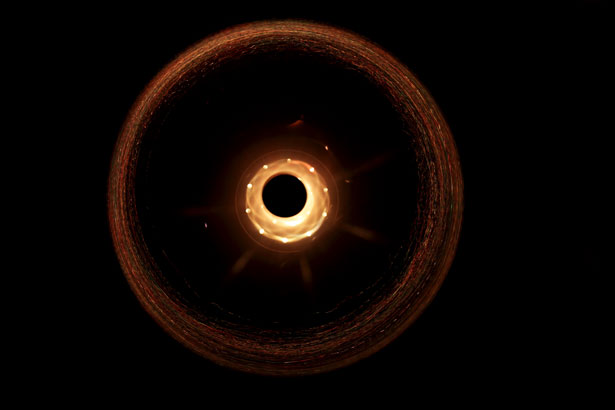
Artist’s impression of a black hole’s gravitational distortion.
⭐ How Black Holes Form
Most black holes are born when massive stars reach the end of their lives and explode as supernovae, leaving behind extremely dense remnants.
The core collapses under its own weight and becomes a black hole.
Other types include:
- Intermediate black holes (rare)
- Supermassive black holes (found in galaxy centers)
- Primordial black holes (hypothetical, from the early universe)
Below is the real image of a supermassive black hole, captured in 2019:
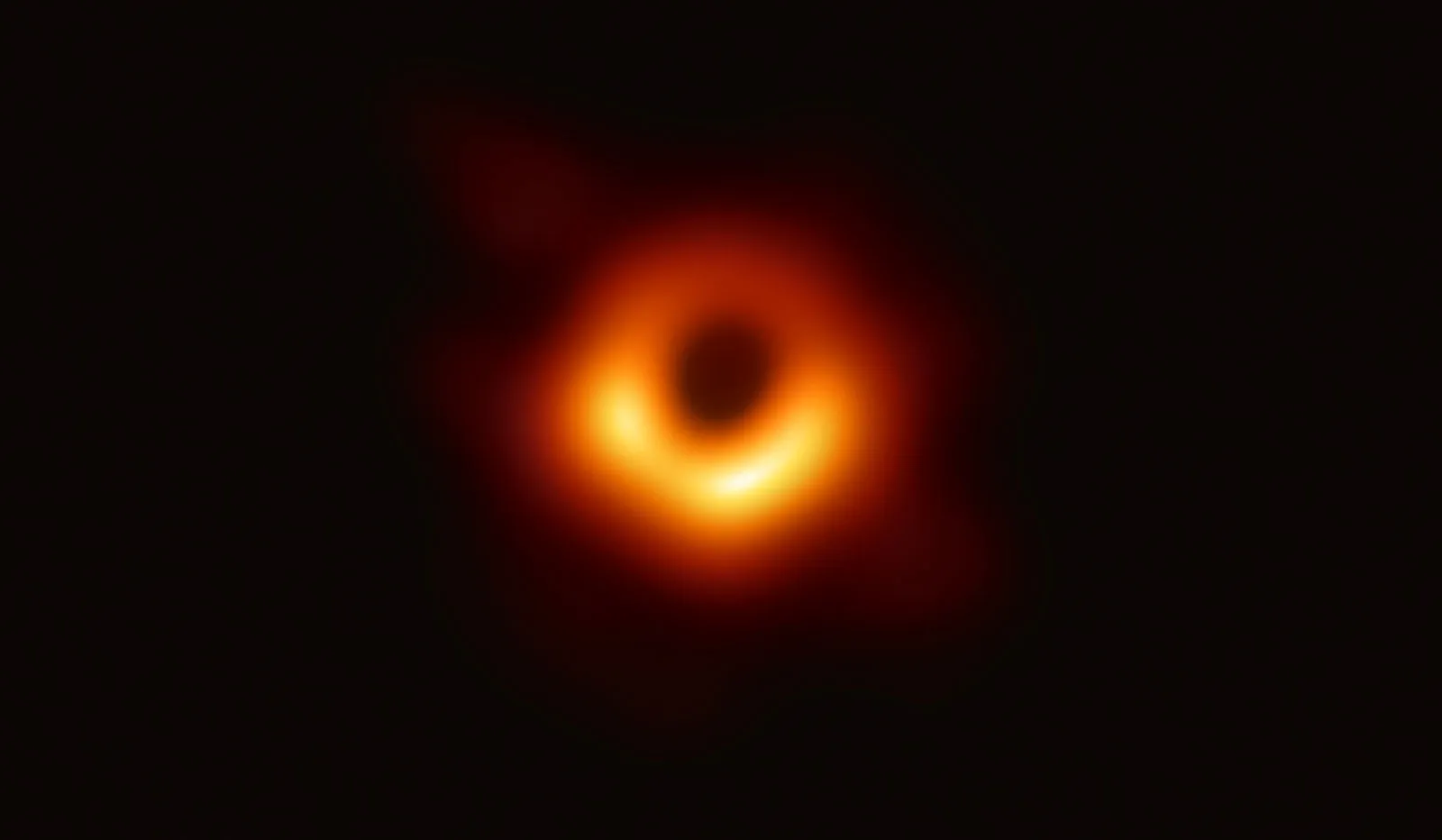
The first real image of a black hole — M87*, photographed by the Event Horizon Telescope.
👨🔬 Who Discovered Black Holes?
Understanding black holes wasn’t the work of one person — it was a scientific journey spanning centuries.
Each scientist below added a crucial piece to the puzzle.
🧠 1783 — John Michell
John Michell was an English natural philosopher, geologist, astronomer, and arguably one of the most underrated scientists in history.
He was the first person to ever propose the idea of a “dark star” — a star so massive that not even light could escape its gravity.
This idea sounds exactly like a modern black hole, but he came up with it over 130 years before Einstein.
What makes Michell impressive:
- He predicted gravitational lensing centuries before it was detected
- He invented the concept of stellar mass comparison
- He developed early theories on earthquakes and magnetism
- He worked entirely without modern physics or relativity
Most scientists ignored his idea because it sounded too strange for the time.
But today, Michell is recognized as the first person in history to describe a black hole-like object.
🧪 1915 — Albert Einstein
Albert Einstein revolutionized physics with the publication of the General Theory of Relativity.
Relativity did two things:
- Redefined gravity not as a force, but as a curvature of spacetime
- Predicted black holes mathematically — even though Einstein himself thought they were too bizarre to exist
Einstein’s contribution is foundational:
- His equations showed that gravity could become infinitely strong
- He predicted gravitational time dilation
- He enabled the entire theoretical framework black holes rely on
- His work later made gravitational waves possible (detected in 2015)
Even though Einstein didn’t believe black holes were physical objects, his math made them unavoidable.
📘 1916 — Karl Schwarzschild
One year after Einstein published relativity, Karl Schwarzschild — a German physicist serving on the front lines of World War I — solved Einstein’s equations from inside the trenches.
His solution described:
- the first mathematically perfect black hole
- the Schwarzschild radius, the boundary we now call the event horizon
- how mass curves spacetime in a perfectly spherical object
Schwarzschild’s work showed that black holes weren’t just theoretical quirks — they were built into the structure of the universe.
Tragically, he died just months later from an autoimmune disease.
But his name remains attached to every non-rotating black hole ever studied.
🌌 1960s — John Wheeler
John Wheeler was an American physicist who helped bring black holes into mainstream science.
What Wheeler did:
- Coined the term “black hole” in 1967
- Developed key theoretical concepts including wormholes and spacetime foam
- Mentored future legends like Richard Feynman and Kip Thorne
- Unified the physics community around Einstein’s ideas
Before Wheeler, black holes were seen as obscure, fringe solutions.
After Wheeler, they became central objects in astrophysics.
He transformed the idea from “mathematical oddity” to scientific reality.
Wheeler also helped promote the idea that black holes could shape galaxies and influence cosmic evolution — concepts widely accepted today.
🛰️ 2019 — Event Horizon Telescope Team
Although not a single person, the global collaboration of more than 200 scientists produced something historic:
✔ the first real image of a black hole (M87*)
✔ proof that event horizons behave exactly like relativity predicts
✔ the highest-resolution astrophysical image ever taken
In 2022, the team also imaged Sagittarius A*, the black hole at the center of the Milky Way.
Their work turned theory into observation.
Here is another historic observation — a black hole in our own galaxy:
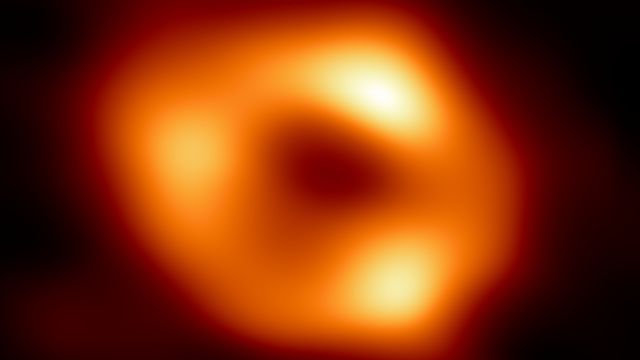
Sagittarius A*, the supermassive black hole at the center of the Milky Way (EHT Collaboration).
🧠 What Scientists Believe Today
Modern astronomy agrees on several key ideas:
✔ Black holes definitely exist
Detected through:
- X-ray emissions
- Stars orbiting invisible massive objects
- Gravitational waves from collisions
✔ They shape galaxies
Most galaxies — including the Milky Way — have supermassive black holes at their centers.
✔ They don’t “suck” everything in
Objects must be very close to fall in.
✔ They can evaporate
Stephen Hawking predicted Hawking radiation, meaning black holes slowly lose mass.
✔ They help unlock quantum gravity
Studying black holes may unify relativity and quantum mechanics.
🔭 How Our Understanding Evolved Over Time
Before 1900 — Speculation
The idea existed but had no evidence.
1916–1960 — Mathematics only
Black holes were seen as strange solutions to Einstein’s equations.
1960–1980 — Evidence grows
X-ray observations showed extremely dense unseen objects.
1990–2010 — Strong confirmation
Precise motions of stars proved the existence of a supermassive black hole in our galaxy.
2019–2022 — Direct imaging
Humanity captured real images of:
- M87*
- Sagittarius A*
These observations turned theory into reality.
🌌 Conclusion
Black holes went from wild speculation to one of the most important topics in modern astrophysics.
They:
- shape galaxies
- influence cosmic evolution
- challenge our understanding of physics
- inspire curiosity in every generation
Black holes aren’t just cosmic monsters —
they’re keys to understanding the universe itself.